AI takeoffs and estimating in 2026: what the tools do, and what still needs an estimator
Software can now count every door on a plan set in seconds and flag where the civil and landscape sheets disagree. That's real progress. But a takeoff is not an estimate, and the gaps that cost owners money are mostly the ones a drawing doesn't show.
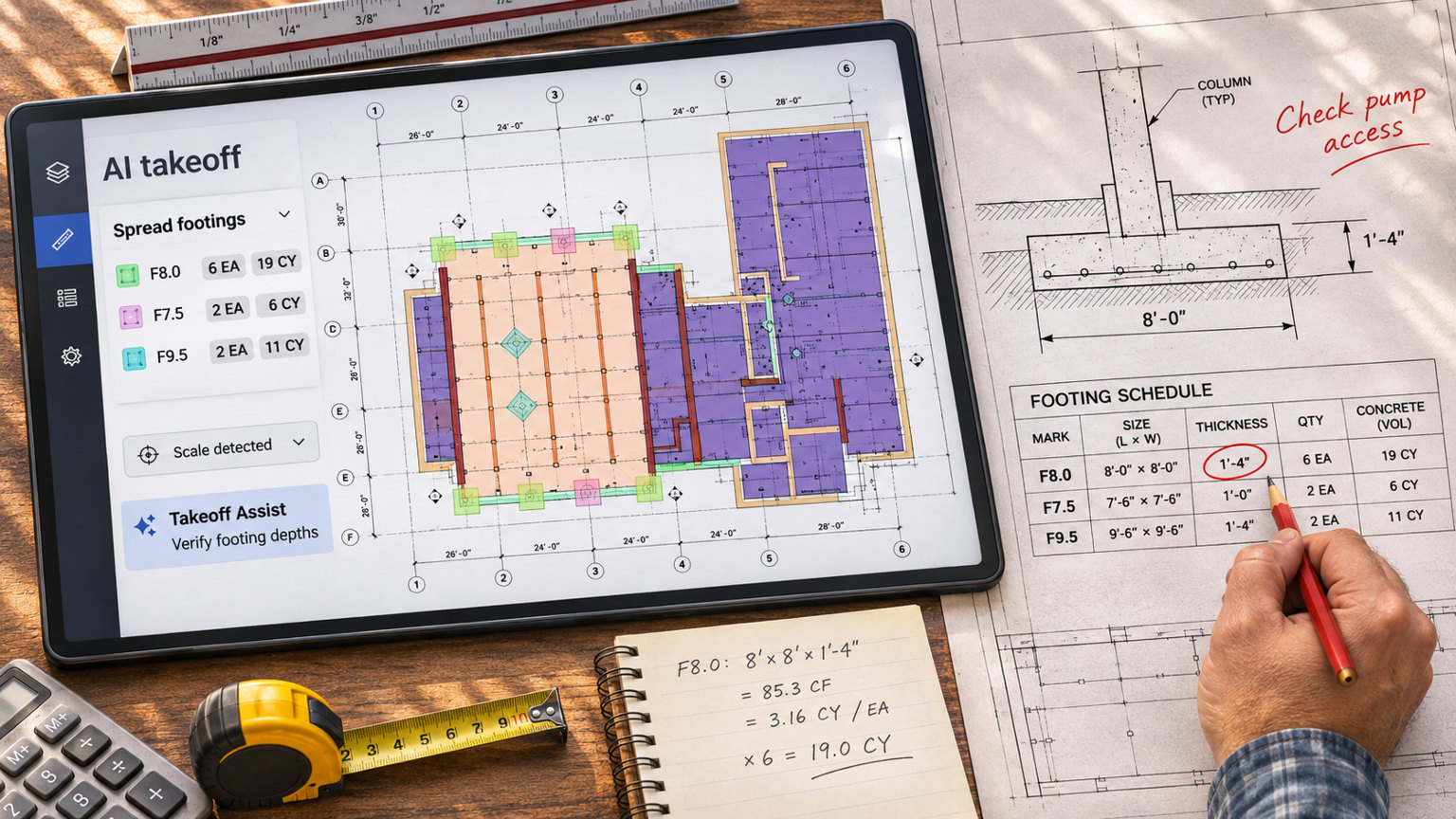
In the illustration, the software counts six spread footings and calculates about 19 cubic yards of concrete. Before we price the pour, we verify the footing thickness against the structural schedule and check whether a truck can reach the work. If the pour needs a pump, we check whose quote includes it.
That's the split this article is about. AI is now good at the counting and measuring, and contractors are using it: in the AGC and Sage outlook survey for 2026, 23% of firms said they use AI for estimating (AGC report). The decisions that change the bid, such as the thickness, the access, and who is carrying the pump, still sit with the estimator.
We price multifamily, townhome and commercial work in the Charlotte area, and the estimate is where our preconstruction work starts. This is our view of what the tools do well, where they fall short, and how to check an estimate that used them.
Four kinds of tools, often confused
"AI estimating" covers several different jobs. It helps to separate them, because each one fails in its own way.
| Category | Examples | What the AI does now |
|---|---|---|
| Takeoff (measuring the drawings) | On-Screen Takeoff and PlanSwift with Takeoff Boost, STACK, Togal.AI, Kreo, Procore Estimating, Bluebeam Revu | Detects rooms, walls, doors, windows and symbols; measures areas and lengths; counts repeated items across sheets |
| Document checking and search | Civils.ai, plus AI assistants built into several takeoff and document platforms | Cross-checks sheets and specs for conflicts; answers questions across a bid set |
| Bidding and bid leveling | ConstructConnect, Autodesk BuildingConnected / Forma Bid, Procore | Finds projects and invites subs; reads proposals into a comparable format (Autodesk's Bid Proposal Agent, in beta) |
| Cost data | RSMeans, a contractor's own historical cost records | Supplies unit costs by region; mostly data, not AI |
Based on vendor product pages and announcements checked 19 November 2026. Examples are illustrative, not an endorsement or a complete list. Features change quickly; confirm with each vendor.
Counting, measuring and repetition
AI takeoff is at its best on clean, vector PDFs with repeated elements. Think doors, windows, plumbing fixtures, light fixtures, room areas and wall lengths on a residential or multifamily plan set. A duplex and triplex community like the ones we build repeats the same few unit plans many times. That's exactly the kind of set where automatic counts save hours and cut the miscounts that come from tired eyes late in a bid week.
ConstructConnect says its Takeoff Boost cuts time spent on symbol detection and measurement by up to 95%. Civils.ai says its users need up to 90% less manual effort. Those are vendor figures, not independent tests, but the direction matches what estimators report: the measuring part of a takeoff is getting much faster.
The quieter benefit is coverage. When counting is cheap, an estimator can take off more of the set, run alternates, and spend the time saved on scope review instead of clicking.
Accuracy claims, scale and scanned sets
Vendors commonly quote accuracy of 95% to 98%. We haven't found an independent benchmark that compares tools on the same drawings, and a headline percentage doesn't tell you which quantities to trust on your set. What matters is checking the places where a small error turns into a large cost:
- Scale. Plans printed or exported at the wrong scale, or sheets with several details at different scales, are a common source of large errors. Verify a known dimension in each differently scaled view you measure, not just once per sheet. Most takeoff tools let you set a separate scale for each detail or viewport (Bluebeam's guide shows how).
- Scanned and older drawings. Tools read vector PDFs much better than scans, hand-drawn sheets or marked-up redlines. Civils.ai, for example, offers no accuracy guarantee for pre-1975 hand-drawn sheets.
- Things that aren't symbols. Sitework, grading, demolition, existing conditions and anything described only in a note or spec section are hard for vision models. These scopes are also where budgets most often break.
- Assemblies. Whether a wall is a 2-hour rated unit separation, a shear wall or a plain partition changes its cost per foot many times over. Some tools now recognize wall tags or types. Either way, follow each detected tag to the wall or assembly schedule, confirm the assembly it calls for, and confirm that's the assembly the subcontractor priced.
Some vendors handle this by putting people back in the loop. Civils.ai, for instance, says a QA team reviews each AI takeoff and aims to return it within 24 hours. That's a sensible design, but it also tells you the output isn't yet trusted to stand on its own.
Quantities are the start, not the price
Even a perfect takeoff answers only "how much." The estimate also has to answer "at what cost, by whom, when and with what risk." Most of those answers aren't on the drawings:
- Local pricing. Labor and material costs in the Charlotte market move with trade availability and lead times. National cost databases are a useful check, but current subcontractor and supplier quotes set the price.
- Waste, laps and means and methods. Sheet goods, framing lumber, concrete and roofing all carry waste and overlap factors that depend on the layout and the crew.
- General conditions and schedule. Supervision, temporary utilities, equipment, insurance, permits and the length of the job aren't drawn anywhere.
- Scope gaps between trades. Who provides blocking, firestopping, sleeves, final grading or utility connections? Bid leveling is where those gaps are found, and it depends on reading each sub's exclusions.
- Contingency and risk. How complete the drawings are, the site's unknowns and price escalation are judgment calls.
This matches how the industry itself frames it. AGC's own estimating training treats AI as support for the estimator's judgment, used for document review, scope checks and validating assumptions, with the estimator still accountable for the number.
Catching conflicts before they become change orders
The most valuable AI feature for owners may not be takeoff at all. It's checking. Tools such as Civils.ai cross-check sheets against each other (civil against landscape, architectural against structural) and flag discrepancies by severity. AI search across a bid set can answer questions like "where is the fire rating for the corridor walls specified?" in seconds.
Conflicts found during bidding become RFIs and clarifications. The same conflicts found in the field become change orders, delays and disputes. On a tight multifamily budget, catching a mismatched finished-floor elevation or a missing detail before contract is worth more than a faster count.
Leveling bids is getting easier, but exclusions still need reading
Bid platforms such as ConstructConnect and BuildingConnected have long handled finding projects, inviting subcontractors and collecting bids. The new step is reading the proposals. Autodesk's Bid Proposal Agent, in beta in Forma Bid, turns subcontractor proposal PDFs into structured bid data. Other tools pull out inclusions and exclusions so bids can be compared side by side.
That's useful, because proposals arrive in every format imaginable. But the lowest number on a leveled sheet is often low because something is excluded. The AI can list the exclusions; someone still has to decide who carries each one, and call the sub when the wording is unclear.
The bottom line
AI has made the measuring part of estimating faster and the checking part more thorough, and both will keep improving. What it hasn't changed is where estimates go wrong: scope that isn't drawn, assemblies that are misclassified, exclusions nobody picked up, and prices that don't reflect the local market. When you receive an estimate, ask how the numbers were checked, not just how they were produced.
Before you accept an estimate, ask your contractor
- What did the bid leveling find excluded, and who is carrying each exclusion?
- Which drawing set and revision was the takeoff run on, and was the scale verified in each detail that was measured?
- Which quantities came from automatic detection, and which did an estimator measure or check by hand?
- Were wall, floor and footing assemblies checked against the schedules, and do they match what the subcontractors priced?
- How were sitework, demolition, access and scope shown only in notes or specs handled?
- Where do unit prices come from: current local subcontractor and supplier quotes, a cost database or historical costs?
- What conflicts or RFIs did the document review turn up, and how are they priced or qualified?
Need a budget you can build to?
We'll review your drawings, take off and price the work, and show you the assumptions behind every number.
Or call (704) 774-5148. SPR Construction LLC, Waxhaw, NC. NC General Contractor License 76483 (Building).
Sources: AGC and Sage, Dampened Expectations: The 2026 Construction Hiring and Business Outlook (951 respondents, surveyed 4 November to 15 December 2025; response counts vary by question); ConstructConnect Takeoff Boost announcement (22 April 2026); Bluebeam support, setting page scale; Civils.ai product and pricing pages; Autodesk Construction blog, Autodesk University 2026 product highlights; Togal.AI, STACK, Kreo, Procore Estimating and Bluebeam product pages. Checked 19 November 2026.
Product names are trademarks of their owners. SPR Construction has no commercial relationship with the vendors named. Products are mentioned as examples, not endorsements. Vendor accuracy and time-saving figures are the vendors' own claims. Features and pricing change often; confirm with each vendor.
Last updated: 19 November 2026.